
Clinical record with visibility layers for a mental health clinic
This case has been anonymised at the client’s request: the name, logo and people’s names are hidden or blurred in the images.
Mental health clinic
As the solo Product Designer on this project, I turned a vague brief into a unified clinical records system.
Figma prototype reproduced with the project screens.
The case at a glance
- The problem
- The request was for a system focused on session notes, with no specification. Reframing revealed a different problem: clinical records did not belong to the clinic or circulate with controlled access.
- My role
- Product Designer, end to end
- My contribution
- As the solo Product Designer, I turned a vague brief into a unified clinical records system.
- My involvement
- Freelance project · anonymised client
- The decision
- A single clinical record with visibility layers, only the progress note required, and aggregated indicators for management.
- Usability testing
- Usability testing with 5 people identified 7 issues, all corrected in the components.
Deliverables, methods and scope
22 prioritised requirements, a permissions matrix, 7 tested wireframes, brand identity, 20 components with Figma variables and 15 screens in light and dark themes.
Written questionnaire, reading the regulations, interviews by profile, job stories, MoSCoW prioritisation, permissions matrix and usability testing.
The clinic is a real client and has been anonymised at her request. Interviews and testing were conducted with real people; the cited regulations (CFP, CFM and Law 13.787/2018) are real. I have no production usage data.
A vague request, with no specification.
A psychology and psychiatry clinic asked for a care system focused on session notes. There were no requirements, user profiles or access rules.
Read more
As the solo Product Designer, I turned a vague brief into a unified clinical records system.
Every word hid a decision.
Who uses it besides therapists? Are personal notes and clinical records the same thing? What do CFP, CFM and LGPD require? What counts as success?
Read more
First step: a written questionnaire with 25 questions, before any screens.
Reduce ambiguity before designing.
I read the original regulations (CFP 001/2009, CFM 1.638/2002 and Law 13.787/2018), conducted eight interviews, one per recording profile, and separated legal questions from design questions.
Read more
Five legal questions were marked as blockers: without answers, the permissions could not be designed.
The problem was not where to write notes.
Clinical records did not belong to the clinic or circulate with controlled access. They stayed in notebooks and personal documents, and exchanges between psychologist and psychiatrist went through WhatsApp.
Read more
Main metric: percentage of sessions recorded on the same day, with a 90% pilot target. Guardrail metric: team trust.
Only the progress note is required
- The finding
- CFP Resolution No. 001/2009 requires only a progress note for each session. In the interviews, practitioners who wrote narrative notes resisted long forms.
- Design response
- Progress note as the only required field, with optional blocks in each practitioner’s template. Accepted trade-off: less comparable data across practitioners.
Every record says who can read it
- The finding
- The biggest adoption risk was fear of exposing what was written.
- Design response
- A label on each record names who can see it, such as “Only you” or “You and the psychiatrist”. Nothing is shared by default; the patient gives consent by information type.
Clinical record · Visual design
Visibility labels identify who can read each record.
Seven issues, seven component changes.
Usability testing with 5 people identified 7 issues, all corrected in the components. For example, “Shared” did not say with whom, and the draft label looked like an error.
Read more
Reception and management screens have not yet been tested.
Management sees numbers, never content
- The finding
- If management could see how long each practitioner spent documenting sessions, an adoption metric would become surveillance.
- Design response
- Indicators are always aggregated. Emergency access requires a justification, and the access is logged.
One system for five profiles.
15 screens for 5 profiles: practitioners, reception and management. 20 Atomic Design components, with the same names in Figma and React. The dark theme is a variable mode change.
Read more
All text meets 4.5:1 contrast in both themes, and no state relies on colour alone (WCAG 2.2 AA).
Light and dark themes with the same components
Project screens, in Portuguese. Logo and names blurred at the client’s request.
Empty, loading and error states
Project screens, in Portuguese. Logo and names blurred at the client’s request.
Record a session in a few minutes
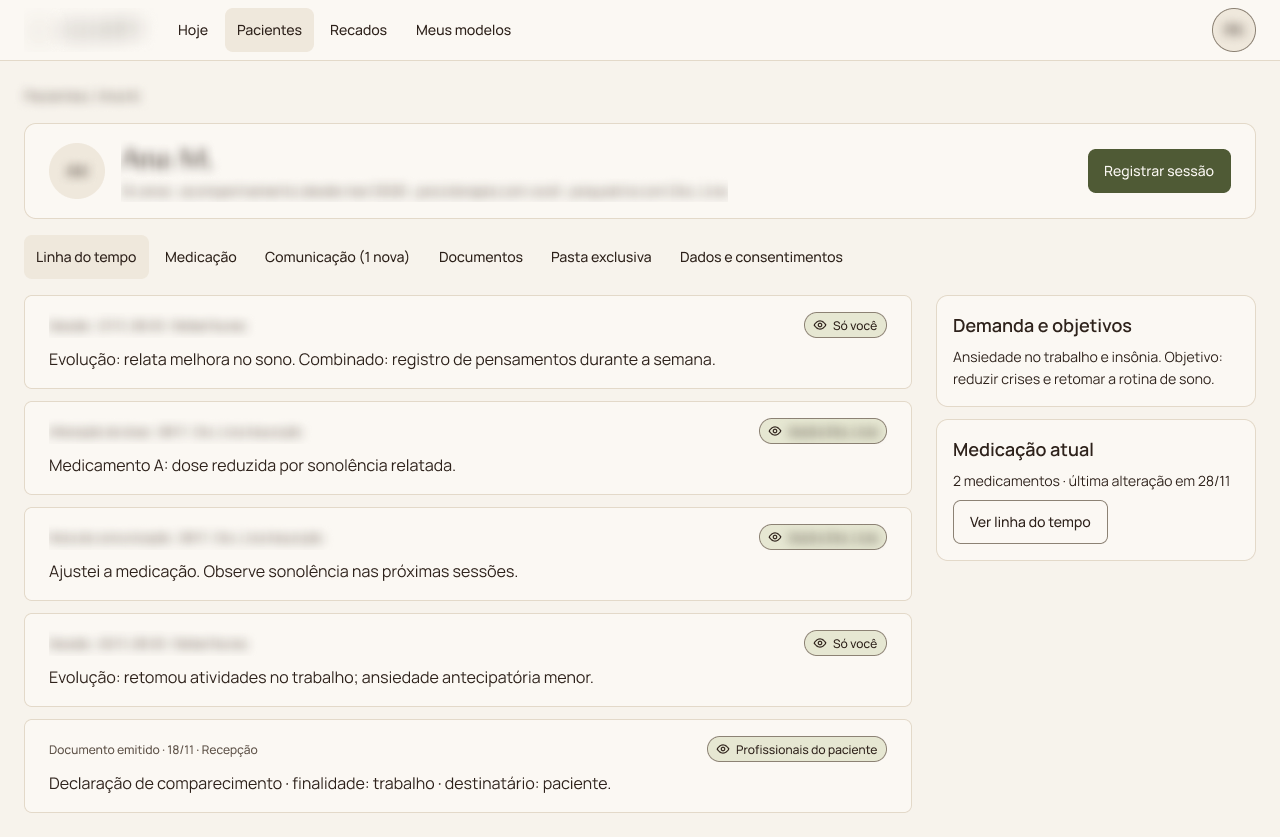 Before the session: timeline
Practitioner departure without losing continuity
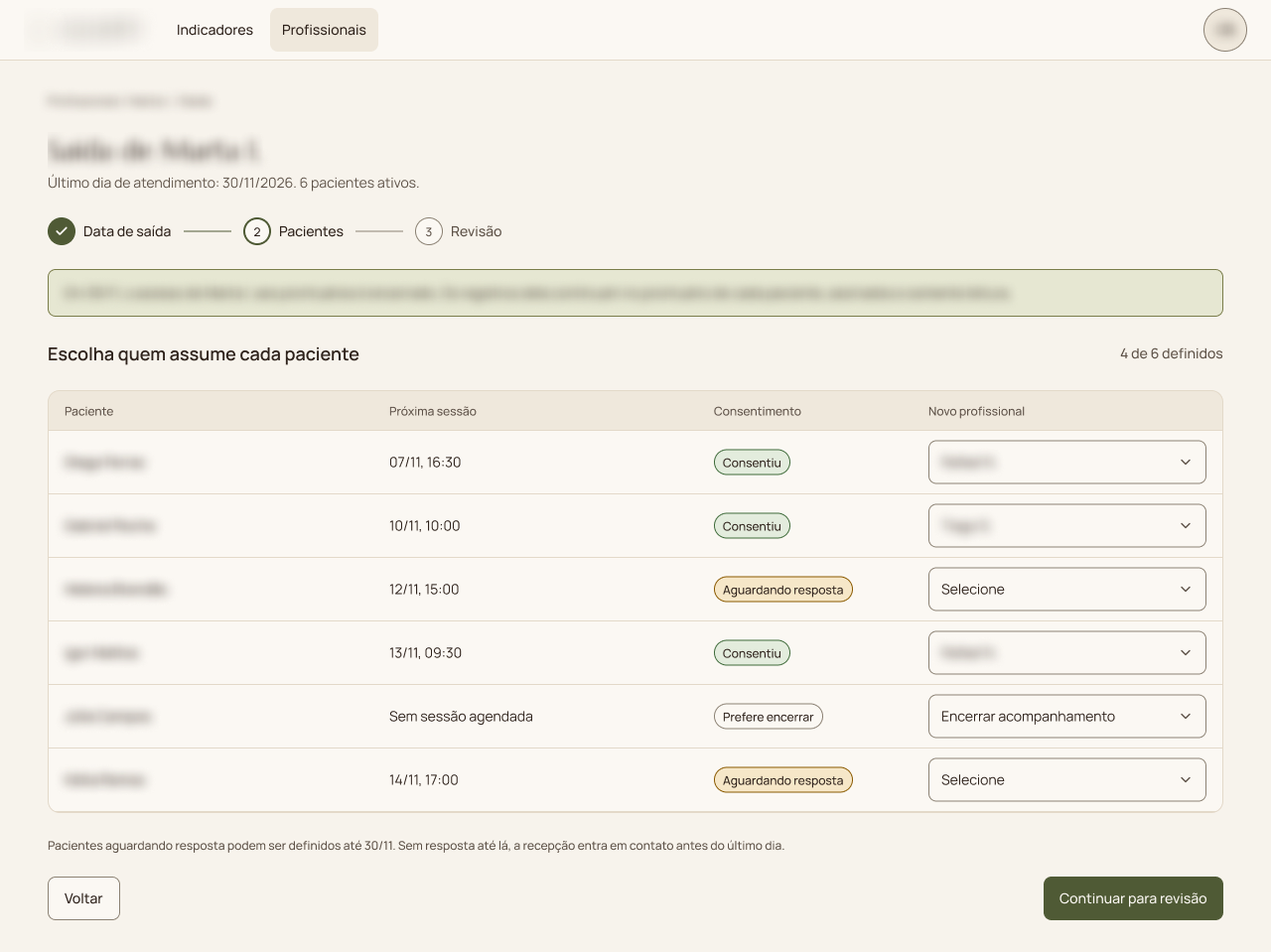 Who takes over each patient
Management without reading clinical content
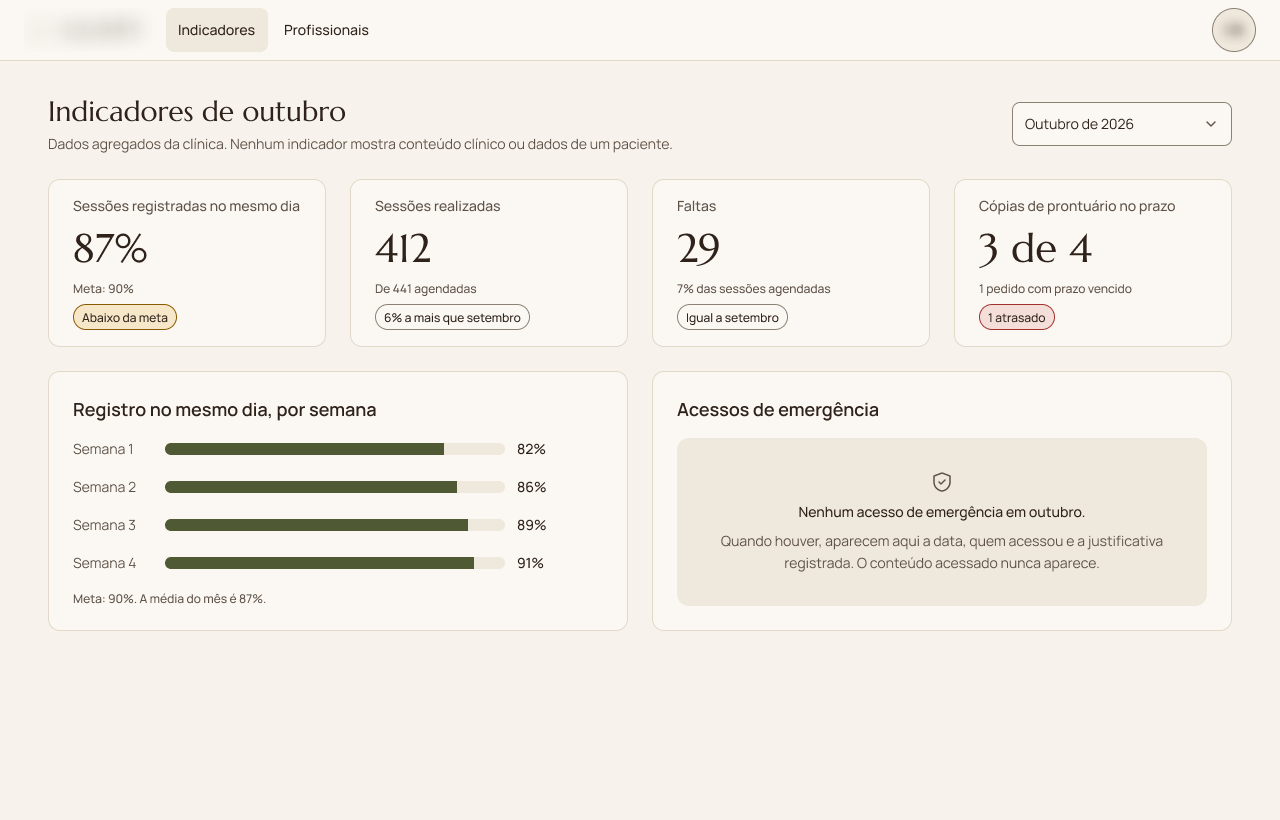 Aggregated indicators
View the complete screen gallery
What I would do differently.
I would involve legal advisers at kickoff and test with reception earlier.
- Observed in validation
- Usability testing with 5 people identified 7 issues, all corrected in the components.
- What this could mean for the business
- The proposed target is to record 90% of sessions on the same day in the pilot group. It is still a hypothesis.
- What I would measure next
- Retest with practitioners: a written questionnaire with 5 people and an unmoderated test with 3 to 5, comparing findings with the case hypotheses.
Read more
Next step: another round of validation with practitioners.