Digital catalogue for a textile manufacturer founded in 1930
A Penteadora
I brought fabric specifications and side-by-side comparison to mobile, for representatives to use during sales visits.
Find, inspect and compare fabrics.
Project screens presented in sequence, not a recording of the prototype.
Representatives needed technical information during the sales conversation. Their reviews brought specifications beside the image and gave comparison a dedicated screen; this was not a measured speed improvement.
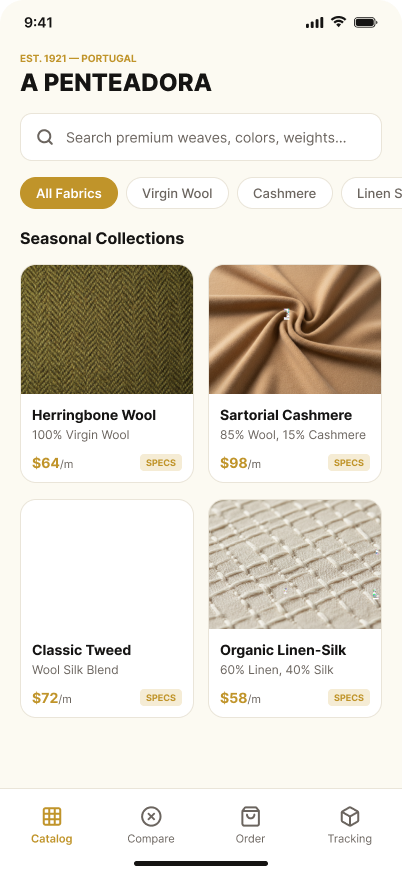 Browse the collection
The case at a glance
- The problem
- The printed catalogue took two months to produce and could not be corrected after shipping. Representatives still needed physical samples.
- My role
- Sole Product Designer
- The decision
- After observing sales visits, I designed for mobile use, with technical filters and side-by-side comparison. I kept the factory reference codes.
- What I observed
- Representatives reviewed the prototypes. Their feedback led me to give comparison its own screen and place specifications next to the image. I did not measure a task success rate.
- Why it matters to the business
- The catalogue was designed for use during sales visits and to allow updates after a collection was released. Without a launch, I could not measure time or cost savings.
- What was not measured
- Launch was subject to group approval. Cost savings and order speed were not measured.
Deliverables and methods
39 screens and nine documented components for catalogue, search, comparison and orders.
I observed sales visits, compared other catalogues and developed prototypes from early sketches to detailed screens for review with representatives.
Designing the first digital catalogue.
I designed a catalogue and reusable interface foundation for a Portuguese textile manufacturer founded in 1930. The work ran from February 2022 to February 2023.
Read more
The company sells internationally and had no prior digital product or component library. I worked from discovery through catalogue design and prototype reviews with the commercial team.
Each collection took two months to become a catalogue.
Physical catalogues required printing, cutting, gluing samples and international shipping. Three teams and two months stood between a finished collection and the representative.
Read more
Digitisation had to preserve trust in texture and colour, not merely reduce printing. The digital catalogue was never intended to replace tactile samples in high-value sales.
The physical starting point
Photograph of the company’s physical catalogue.
I observed how fabrics were presented in client visits.
Shadowing in client visits and international fairs revealed representatives comparing fabrics while standing, moving and speaking with customers. Benchmarking explored texture and colour fidelity.
Read more
Representatives consulted composition and weight while speaking, compared references side by side and needed to find a fabric in seconds. These observed behaviours shaped the hierarchy.
Research and reference analysis
Research materials. The scores compare reference catalogues, not this project’s performance.
I connected internal codes to technical search.
I retained internal references and added searchable attributes: composition, weight, finish and use. Large touch targets and visible specifications support the sales conversation.
Read more
The factory needed reference codes, but buyers also searched by fabric properties. I kept the codes and added composition, weight and finish; each collection would need that information entered.
Two perspectives on the journey
Persona journeys from the project, in Portuguese. They describe the planned journey, not measured use.
Reference + Composition + Weight + Finish
A proposed searchable catalogue, maintaining internal traceability.
Feedback gave comparison its own screen.
Representatives reviewed low-, medium- and high-fidelity prototypes. Their feedback preserved internal codes, made comparison a dedicated screen and brought specifications beside the image.
Read more
These were prototype reviews without a formal test script or success-rate measurement. They helped me revise the screens. Customers would still need to touch physical samples.
39 screens and a reusable component library.
I delivered 39 mobile-first screens and 9 documented components, supported by typography, spacing and semantic tokens. Catalogue, search, comparison and order flows share the same foundation.
Read more
The intended update flow allows one non-technical person to update or remove a reference. Colour fidelity and consistent photography remain essential to a trustworthy catalogue.
Beyond the mobile screens
Desktop design and presentation mockup, not used in production.
Find, inspect and compare fabrics.
Project screens presented in sequence, not a recording of the prototype.
Representatives needed technical information during the sales conversation. Their reviews brought specifications beside the image and gave comparison a dedicated screen; this was not a measured speed improvement.
Browse the collectionWelcome and account access.
Project screens presented in sequence, not a recording of the prototype.
After observing sales visits, I designed for mobile use, with technical filters and side-by-side comparison. I kept the factory reference codes.
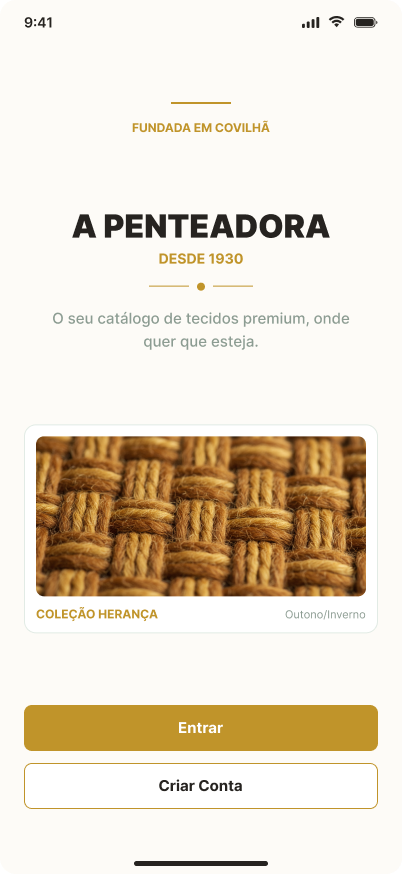 Welcome screen
Order confirmation and follow-up.
Project screens presented in sequence, not a recording of the prototype.
After observing sales visits, I designed for mobile use, with technical filters and side-by-side comparison. I kept the factory reference codes.
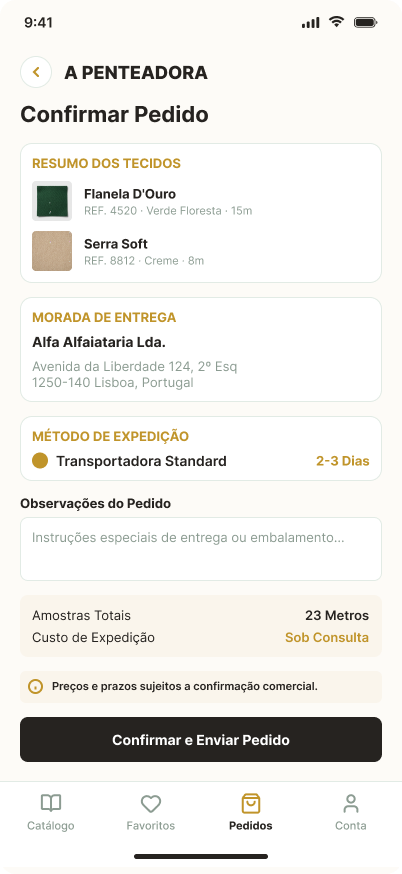 Confirm the order
View the complete screen gallery
What I delivered to the company.
I delivered the catalogue and component library. Launch remained subject to group approval, so the defined business indicators were not measured.
- Observed in validation
- Representatives reviewed the prototypes. Their feedback led me to give comparison its own screen and place specifications next to the image. I did not measure a task success rate.
- What this could mean for the business
- The catalogue was designed for use during sales visits and to allow updates after a collection was released. Without a launch, I could not measure time or cost savings.
- What I would measure next
- After launch, I would measure update time and observe how representatives find fabrics, compare them and order samples, alongside the physical catalogue.
Read more
The representatives helped me understand why codes and physical samples still mattered. I could revise the design, but cost savings and order speed would need to be checked after launch.